

Pass C_AIG_2412 Exam in First Attempt Guaranteed 100% Cover Real Exam Questions [Mar-2026]
Valid C_AIG_2412 test answers & SAP C_AIG_2412 exam pdf
SAP C_AIG_2412 Exam Syllabus Topics:
| Topic | Details |
|---|---|
| Topic 1 |
|
| Topic 2 |
|
| Topic 3 |
|
| Topic 4 |
|
NEW QUESTION # 20
Match the components of a Retrieval Augmented Generation architecture to the diagram.
Answer:
Explanation: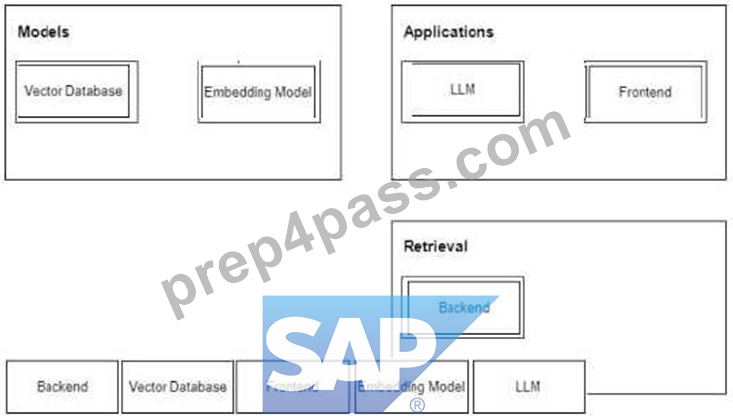
NEW QUESTION # 21
How can Joule improve workforce productivity? Note: There are 2 correct answers to this question.
- A. By resolving hardware malfunctions.
- B. By maintaining strict adherence to data privacy regulations.
- C. By offering generic task recommendations unrelated to specific roles.
- D. By providing context-based role-specific task assistance.
Answer: B,D
NEW QUESTION # 22
Which of the following steps must be performed to deploy LLMs in the generative Al hub?
- A. Provision SAP AI Core
* Check for foundation model scenario
* Create a configuration
* Create a deployment - B. Run the booster
* Create service keys
* Select the executable ID - C. Provision SAP AI
* Core Create a configuration
* Run the booster - D. Check for foundation model scenario
* Create a deployment
* Configuring entitlements
Answer: A
NEW QUESTION # 23
What is the primary function of the generative Al hub in SAP's Al Foundation?
- A. To store embeddings of unstructured data for semantic data retrieval
- B. To provide ready-to-use Al services for document processing
- C. To manage the Al lifecycle efforts end-to-end
- D. To serve as an abstraction layer to access a range of foundation Al models
Answer: D
NEW QUESTION # 24
What are some benefits of using an SDK for evaluating prompts within the context of generative Al? Note: There are 3 correct answers to this question.
- A. Automating prompt testing across various scenarios
- B. Maintaining data privacy by using data masking techniques
- C. Creating custom evaluators that meet specific business needs
- D. Providing metrics to quantitatively assess response quality
- E. Supporting low code evaluations using graphical user interface
Answer: A,C,D
NEW QUESTION # 25
Which statement best describes the Chain-of-Thought (COT) prompting technique?
- A. Writing a series of connected prompts creating a chain of related information.
- B. Concatenating multiple related prompts to form a chain, guiding the model through sequential reasoning steps.
- C. Connecting related concepts by having the LLM generate chains of ideas.
- D. Linking multiple Al models in sequence, where each model's output becomes the input for the next model in the chain.
Answer: B
NEW QUESTION # 26
Which of the following are functionalities provided by the generative-Al-hub-SDK ? Note: There are 2 correct answers to this question.
- A. Configure SAP BTP credentials
- B. Customize SAP AI Launchpad
- C. Create chat responses and embeddings
- D. Interact with LLMs
Answer: C,D
Explanation:
The Generative AI Hub SDK offers functionalities that empower developers to:
1. Interact with Large Language Models (LLMs):
* Model Access:The SDK provides a developer-friendly way to consume foundational models available in the SAP Generative AI Hub, facilitating seamless interactions with these models.
2. Create Chat Responses and Embeddings:
* Natural Language Processing:With this SDK, developers can interact with models to create natural language completions, chat responses, and embeddings, enabling the development of sophisticated AI- driven applications.
Conclusion:
The Generative AI Hub SDK enables developers to interact with LLMs and create chat responses and embeddings, supporting the development of advanced AI functionalities within applications.
NEW QUESTION # 27
Which of the following are features of the SAP AI Foundation? Note: There are 2 correct answers to this question.
- A. Joule integration in SAP SuccessFactors
- B. Al runtimes and lifecycle management
- C. Open source Al model repository
- D. Ready-to-use Al services
Answer: B,D
NEW QUESTION # 28
Which technique is used to supply domain-specific knowledge to an LLM?
- A. Prompt template expansion
- B. Fine-tuning the model on general data
- C. Retrieval-Augmented Generation
- D. Domain-adaptation training
Answer: D
NEW QUESTION # 29
What are the applications of generative Al that go beyond traditional chatbot applications? Note: There are 2 correct answers to this question.
- A. To interpret human instructions and control software systems without necessarily producing output for human consumption.
- B. To follow a specific schema - human input, Al processing, and output for human consumption.
- C. To interpret human instructions and control software systems always producing output for human consumption.
- D. To produce outputs based on software input.
Answer: A,C
Explanation:
* C. To interpret human instructions and control software systems without necessarily producing output for human consumption.This is a key area where generative AI is breaking new ground. Think of it as AI acting as a "middleman" between you and software. Here are some examples:
* Automating complex tasks:You could tell the AI to "optimize this database for performance" or
"find and fix security vulnerabilities in this code." The AI would then interact with the software systems to carry out these instructions, without needing to show you every step or result.
* Controlling robots or IoT devices:Imagine instructing an AI to "adjust the lighting in the meeting room" or "have the robot retrieve the package from the warehouse." The AI translates your instructions into actions for those systems.
* Managing cloud resources:AI could dynamically allocate cloud resources based on your needs, scaling them up or down without your direct intervention.
* D. To interpret human instructions and control software systems always producing output for human consumption.This is more in line with traditional chatbot interactions, but with a broader scope. It's about AI generating outputs that are directly useful or informative for humans. Examples include:
* Creating realistic images or videos:Based on your description, the AI could generate a photorealistic image of a new product design or a short video clip for a marketing campaign.
* Writing different kinds of creative text formats:AI can generate stories, poems,articles, summaries, and even code, all tailored to your specifications.
* Providing personalized recommendations:AI can analyze your preferences and provide recommendations for products, services, or information.
Why the other options are incorrect:
* A. To produce outputs based on software input.This is a general capability of AI, not something specific to generative AI or beyond chatbots. Many AI systems analyze software input (like sensor data or log files) to produce outputs.
* B. To follow a specific schema - human input, AI processing, and output for human consumption.
This describes the basic interaction pattern of many AI systems, including chatbots. It's not something that specifically differentiates generative AI or goes beyond typical chatbot applications.
NEW QUESTION # 30
What can be done once the training of a machine learning model has been completed in SAP AI Core? Note: There are 2 correct answers to this question.
- A. The model can be deployed in SAP HANA.
- B. The model can be registered in the hyperscaler object store.
- C. The model can be deployed for inferencing.
- D. The model's accuracy can be optimized directly in SAP HANA.
Answer: B,C
NEW QUESTION # 31
What are some benefits of the SAP AI Launchpad? Note: There are 2 correct answers to this question.
- A. Direct deployment of Al models to SAP HANA.
- B. Integration with non-SAP platforms like Azure and AWS.
- C. Centralized Al lifecycle management for all Al scenarios.
- D. Simplified model retraining and performance improvement.
Answer: C,D
NEW QUESTION # 32
Which of the following are grounding principles included in SAP's AI Ethics framework?
Note: There are 3 correct answers to this question.
- A. Store all user data for legal proceedings
- B. Maximize business profits
- C. Avoid bias and discrimination
- D. Human agency and oversight
- E. Transparency and explainability
Answer: C,D,E
NEW QUESTION # 33
What is a Large Language Model (LLM)?
- A. A rule-based expert system to analyze and generate grammatically correct sentences.
- B. An Al model that specializes in processing, understanding, and generating human language.
- C. A database system optimized for storing large volumes of textual data.
- D. A gradient boosted decision tree algorithm for predicting text.
Answer: B
NEW QUESTION # 34
What is Machine Learning (ML)?
- A. A statistical method for data processing that does not involve any Al techniques.
- B. A form of Al that only focuses on creating new content, including text, images, sound, and videos.
- C. A technology that equips machines with human-like capabilities such as problem-solving, visual perception, and decision-making.
- D. A subset of Al that focuses on enabling computer systems to learn and improve from experience or data.
Answer: A,B,C
NEW QUESTION # 35
Which of the following are grounding principles included in SAP's AI Ethics framework? Note: There are 3 correct answers to this question.
- A. Store all user data for legal proceedings
- B. Maximize business profits
- C. Avoid bias and discrimination
- D. Human agency and oversight
- E. Transparency and explainability
Answer: C,D,E
NEW QUESTION # 36
What does SAP recommend you do before you start training a machine learning model in SAP AI Core?
Note: There are 3 correct answers to this question.
- A. Define the required infrastructure resources for training.
- B. Configure the model deployment in SAP Al Launchpad.
- C. Register the input dataset in SAP AI Core.
- D. Perform manual data integration with SAP HANA.
- E. Configure the training pipeline using templates.
Answer: A,C,E
Explanation:
Before initiating the training of a machine learning model in SAP AI Core, SAP recommends the following steps:
* Configure the training pipeline using templates:Utilize predefined templates to set up the training pipeline, ensuring consistency and efficiency in the training process.
* Define the required infrastructure resources for training:Specify the computational resources, such as CPUs or GPUs, necessary for the training job to ensure optimal performance.
* Register the input dataset in SAP AI Core:Ensure that the dataset intended for training is properly registered within SAP AI Core, facilitating seamless access during the training process.
These preparatory steps are crucial for the successful training of machine learning models within the SAP AI Core environment.
NEW QUESTION # 37
What does SAP recommend you do before you start training a machine learning model in SAP AI Core? Note: There are 3 correct answers to this question.
- A. Define the required infrastructure resources for training.
- B. Configure the model deployment in SAP Al Launchpad.
- C. Register the input dataset in SAP AI Core.
- D. Perform manual data integration with SAP HANA.
- E. Configure the training pipeline using templates.
Answer: A,C,E
NEW QUESTION # 38
What contract type does SAP offer for Al ecosystem partner solutions?
- A. Bring Your Own License (BYOL) for embedded partner solutions
- B. Annual subscription-only contracts
- C. Pay-as-you-go for each partner service
- D. All-in-one contracts, with services that are contracted through SAP
Answer: D
Explanation:
SAP collaborates with a wide ecosystem of partners, including leading general-purpose AI vendors, to provide tailored solutions to its customers. Through the SAP Store, customers have access to numerous partner applications and a variety of tools, allowing them to choose solutions that best fit their requirements.
Contractual Approach:
* All-in-One Contracts:SAP offers all-in-one contracts for AI ecosystem partner solutions, where services are white-labeled and contracted directly through SAP. This approach simplifies the procurement process for customers, as they engage with SAP as the single point of contact for both SAP and partner services.
* Exclusion of Bring Your Own License (BYOL) Model:SAP does not adopt a "bring your own license" model for these embedded partner solutions. Instead, all services are integrated and provided under unified contracts managed by SAP.
Benefits of This Contractual Model:
* Simplified Procurement:Customers benefit from a streamlined purchasing process, dealing with a single contract and point of contact for multiple services.
* Integrated Solutions:The all-in-one contract ensures that partner solutions are seamlessly integrated with SAP's offerings, providing a cohesive experience.
* Assured Compliance and Support:By contracting through SAP, customers can be confident in the compliance, security, and support standards upheld across all services.
NEW QUESTION # 39
Which of the following steps must be performed to deploy LLMs in the generative Al hub?
- A. Run the booster
- B. Provision SAP AI
- C. Provision SAP AI Core
- D. Check for foundation model scenario
Answer: C
NEW QUESTION # 40
Which of the following are functionalities provided by the generative-Al-hub-SDK ? Note: There are 2 correct answers to this question.
- A. Configure SAP BTP credentials
- B. Customize SAP AI Launchpad
- C. Create chat responses and embeddings
- D. Interact with LLMs
Answer: C,D
NEW QUESTION # 41
What are some features of Joule?
Note: There are 3 correct answers to this question.
- A. Generating standalone applications.
- B. Downloading and processing data.
- C. Maintaining data privacy while offering generative Al capabilities.
- D. Providing coding assistance and content generation.
- E. Streamlining tasks with an Al assistant that knows your unique role.
Answer: C,D,E
NEW QUESTION # 42
What are some features of Joule?
Note: There are 3 correct answers to this question.
- A. Generating standalone applications.
- B. Downloading and processing data.
- C. Maintaining data privacy while offering generative Al capabilities.
- D. Providing coding assistance and content generation.
- E. Streamlining tasks with an Al assistant that knows your unique role.
Answer: C,D,E
Explanation:
B: Providing coding assistance and content generation:
* Coding:Joule can help developers write code faster and with fewer errors. Imagine you need to create a simple report in ABAP (SAP's programming language). Instead of remembering the exact syntax and functions, you could describe what you need to Joule in plain English. It could then generate the code snippet, saving you time and reducing the chance of mistakes. This applies to other coding languages too, not just those within the SAP ecosystem.
* Content generation:Joule can create different kinds of content, such as:
* Emails:Need to send a quick update to your team? Tell Joule what information to include, and it can draft the email for you.
* Reports:Joule can analyze data and generate summaries or reports based on your requirements.
* Presentations:Need to create a slide deck? Joule can help you structure it and even suggest relevant content.
* Translations:Joule can translate text between multiple languages, making it easier to collaborate with colleagues around the world.
C: Maintaining data privacy while offering generative AI capabilities:
* Data security is paramount:SAP understands that businesses deal with sensitive data. Joule is built with strong security measures to protect this information. This includes things like encryption and access controls to ensure that only authorized users can see sensitive data.
* Privacy-preserving AI:Joule uses techniques like differential privacy to ensure that AI models don't inadvertently reveal private information while still providing valuable insights. This means that even if Joule learns from your company's data, it won't be possible to reconstruct that data or identify individuals from the AI's output.
D: Streamlining tasks with an AI assistant that knows your unique role:
* Personalized experience:Joule learns about your job title, department, and the tasks you typically perform. This allows it to provide more relevant and helpful suggestions.
* Contextual awareness:Joule understands the context of your work. For example, if you're a financial analyst, Joule will prioritize providing assistance related to finance tasks and data.
* Proactive help:Joule doesn't just wait for you to ask questions. It can anticipate your needs and proactively offer help. For instance, if you're working on a sales forecast, Joule might suggest relevant data sources or provide insights from previous forecasts.
In essence, Joule aims to be a powerful AI assistant that makes your work life easier and more efficient while keeping your data safe and respecting your privacy.
NEW QUESTION # 43
What are some drivers for the rapid adoption of generative AI? Note: There are 2 correct answers to this question.
- A. Significant hardware cost savings
- B. Wide availability
- C. Availability of skilled developers
- D. Ease of use
Answer: B,D
Explanation:
The rapid adoption of generative AI is driven by several key factors:
1. Wide Availability:
* Access to Generative AI Tools:The proliferation of generative AI tools and platforms has made the technology widely accessible to businesses and individuals. This widespread availability facilitates experimentation and integration into various applications.
2. Ease of Use:
* User-Friendly Interfaces:Modern generative AI tools often feature intuitive interfaces that require minimal technical expertise, enabling a broader range of users to leverage AI capabilities without deep technical knowledge.
NEW QUESTION # 44
......
C_AIG_2412 Exam Questions – Valid C_AIG_2412 Dumps Pdf: https://validtorrent.prep4pass.com/C_AIG_2412_exam-braindumps.html
