

Get Apr-2023 updated Exam Cloud-Digital-Leader Dumps with New Questions
100% Pass Guarantee for Cloud-Digital-Leader Exam Dumps with Actual Exam Questions
NEW QUESTION 176
A small scale retailer has been collecting its point of sale transaction in a PostgreSQL Da-tabase. They have raised funding for a strategic expansion goal in the next year that will see them grow significantly in Asia, Europe, North America, Which Database option should they choose in Google Cloud?
- A. Spanner
- B. Bigtable
- C. Cloud SQL
- D. BigQuary
Answer: A
Explanation:
Spanner is a global scale Database that Support SQL querying, Similar to PostgreSQL, Which will be regional. So that will be a fairly smooth move, Since they have the time and the funding, they can plan for this migration.
NEW QUESTION 177
What are the network requirements for Private Google Access?
- A. Private Google Access automatically enables any API.
- B. Your network must have appropriate routes for the destination IP ranges used by Google APIs and services.
- C. None of the Above
- D. Both A and B
Answer: B
Explanation:
Network requirements for Private Google Access:
- Because Private Google Access is enabled on a per-subnet basis, you must use a VPC network. Legacy networks are not supported because they don't support subnets.
- Private Google Access does not automatically enable any API. You must separately enable the Google APIs you need to use via the APIs & services page in the Google Cloud Console.
- If you use the private.googleapis.com or the restricted.googleapis.com domain names, you'll need to create DNS records to direct traffic to the IP addresses associated with those domains.
- Your network must have appropriate routes for the destination IP ranges used by Google APIs and services. These routes must use the default internet gateway next hop. If you use the private.googleapis.com or the restricted.googleapis.com domain names, you only need one route (per domain). Otherwise, you'll need to create multiple routes.
- Egress firewalls must permit traffic to the IP address ranges used by Google APIs and services. The implied allow egress firewall rule satisfies this requirement. For other ways to meet the firewall requirement.
NEW QUESTION 178
Your organization wants to migrate your on-premises environment to Google Cloud. The on-premises environment consists of containers and virtual machine instances. Which Google Cloud products can help to migrate the container images and the virtual machine disks?
- A. Dataflow and BigQuery
- B. Artifact Registry and Cloud Storage
- C. Compute Engine and Filestore
- D. Pub/Sub and Cloud Storage
Answer: C
NEW QUESTION 179
Your organization needs to process large amounts of data from an online application that operates continuously. You do not want to be required to provision infrastructure or create server clusters. What should your organization choose?
- A. Dataflow
- B. Google Kubernetes Engine with Cloud Bigtable
- C. Dataproc
- D. Compute Engine with BigQuery
Answer: D
NEW QUESTION 180
A large travel services company has been running all their workloads on Google Cloud in the previous year. They looked at their past usage of cloud resources and see that there is a consistent use of 10,000 virtual machines throughout the year. Based on the projections for the following year they have a strong indication that they will use at least this much or more capacity within Google Cloud. What is one way in which they can take advantage of this knowledge?
- A. They can use these numbers to negotiate a better contract with another public cloud number.
- B. They can get into a committed use contract with Google Cloud to get a significant discount on the usage of VMs.
- C. They can ask for a sustained use discount.
- D. They can cut costs by cutting down on the number of VMs used.
Answer: B
Explanation:
Compute Engine lets you purchase committed use contracts in return for deeply discounted prices for VM usage. These discounts are referred to as committed use discounts. Committed use discounts are ideal for workloads with predictable resource needs. When you purchase a committed use contract, you purchase Compute Engine resources-such as vCPUs, memory, GPUs, local SSDs, and sole-tenant nodes-at a discounted price in return for committing to paying for those resources for 1 year or 3 years. The discount is up to 57% for most resources like machine types or GPUs. The discount is up to 70% for memory-optimized machine types.
NEW QUESTION 181
A company with its own private data center has called you in for help with their disaster recovery planning. News of multiple ransomware attacks has made them very anxious. They want to make they are well prepared for such an eventuality. Which of these would be good recommendations?
- A. It is better to have redundancy; so, set up another private data center nearby so that you can quickly go over in case of an emergency.
- B. It is better to have redundancy; use one or many of the Google Cloud datacenters as a backup location.
- C. The one data center is enough, as long as the data is encrypted; attackers won't be able to read the data.
- D. The one data center is enough as long as you regularly back up data and save it in another place in the same DC.
Answer: B
Explanation:
A single data center is vulnerable. So any option involving that is not good.
Reference Link:- https://www.coresite.com/blog/data-center-redundancy
NEW QUESTION 182
Which Google Cloud product is designed to reduce the risks of handling personally identifiable information (PII)?
- A. Google Cloud Armor
- B. Secret Manager
- C. Cloud Storage
- D. Cloud Data Loss Prevention
Answer: D
NEW QUESTION 183
Google offers Firebase, In terms of Firebase Console, any particular message that has to be deliv-ered to a customer at a certain degree of change in behavior can be managed through _________________.
- A. Notification Composer
- B. None of the above
- C. Firebase Remote config.
- D. A/B testing
Answer: A
Explanation:
You can send notification messages using the Notifications composer in the Firebase console. Though this does not provide the same flexibility or scalability as sending messages with the Admin SDK or the HTTP and XMPP protocols, it can be very useful for testing or for highly targeted marketing and user engagement. The Firebase console provides analytics-based A/B testing to help refine and improve marketing messages.
After you have developed logic in your app to receive messages, you can allow non-technical users to send messages per the instructions on the Notifications page in the Firebase Help Center.
NEW QUESTION 184
Your organization needs to restrict access to a Cloud Storage bucket. Only employees who are based in Canada should be allowed to view the contents.
What is the most effective and efficient way to satisfy this requirement?
- A. Deploy the Cloud Storage bucket to a Google Cloud region in Canada
- B. Configure Google Cloud Armor to allow access to the bucket only from IP addresses based in Canada
- C. Create a group consisting of all Canada-based employees, and give the group access to the bucket
- D. Give each employee who is based in Canada access to the bucket
Answer: C
Explanation:
Reference:
Because you can use your own private VPN to access the Canada-only bucket from anywhere in the world.
NEW QUESTION 185
Your organization is developing and deploying an application on Google Cloud. Tracking your Google Cloud spending needs to stay as simple as possible.
What should you do to ensure that workloads in the development environment are fully isolated from production workloads?
- A. Apply a unique tag to development resources
- B. Put the development resources in their own project
- C. Associate the development resources with their own billing account
- D. Associate the development resources with their own network
Answer: B
Explanation:
Reference:
Project resources are components that are necessary for successful project implementation. They include people, equipment, money, time, knowledge - basically, anything that you may require from the project planning to the project delivery phases.
NEW QUESTION 186
You are a program manager within a Software as a Service (SaaS) company that offers rendering software for animation studios. Your team needs the ability to allow scenes to be scheduled at will and to be interrupted at any time to restart later. Any individual scene rendering takes less than 12 hours to complete, and there is no service-level agreement (SLA) for the completion time for all scenes. Results will be stored in a global Cloud Storage bucket. The compute resources are not bound to any single geographical location. This software needs to run on Google Cloud in a cost-optimized way.
What should you do?
- A. Develop the application so it can run in an unmanaged instance group
- B. Create a reservation for the minimum number of Compute Engine instances you will use
- C. Deploy the application on Compute Engine using preemptible instances
- D. Start more instances with fewer virtual centralized processing units (vCPUs) instead of fewer instances with more vCPUs
Answer: C
NEW QUESTION 187
Your organization runs an application on virtual machines in Google Cloud. This application processes incoming images. This activity takes hours to create a result for each image. The workload for this application normally stays at a certain baseline level, but at regular intervals it spikes to a much greater workload. Your organization needs to control the cost to run this application.
What should your organization do?
- A. Run the workload on preemptible VM instances
- B. Purchase committed use discounts for the expected spike load
- C. Leverage sustained use discounts for your virtual machines
- D. Purchase committed use discounts for the baseline load
Answer: C
Explanation:
The idea of the Sustained Use discount is that the longer you run a VM instance in any given month, the bigger discount you will get from the list price.
NEW QUESTION 188
The government has mandated that companies in a particular section of healthcare must retain all the data they collect for a period of 10 years in case an audit needs to be done. Your client, who is in that industry, needs to follow regulations. In addition, your client wants to do an analysis of the data quite frequently in the first year. They also don't want to be liable for any data beyond year 10. What would recommend for your customer?
- A. Use Cloud Storage with standard storage in year one and archival storage thereaf-ter. Use Object lifecycle management to move between storage types and delete them after 10 years.
- B. Use Cloud Storage with standard storage in year one and Coldline storage there-after. Set a Cloud Scheduler trigger for 1 year to change storage types and 10 years to delete the data.
- C. Use Cloud Storage with standard storage in year one and Coldline storage there-after. Set a Cloud Tasks to trigger for 1 year to change storage types and 10 years to delete the data.
- D. Use Cloud Storage with nearline storage in year one and Coldline storage thereaf-ter. Use Object lifecycle management to move between storage types and delete them after 10 years.
Answer: A
Explanation:
Cloud storage supports Object Lifecycle Management. To support common use cases like setting a Time to Live (TTL) for objects, retaining noncurrent versions of objects, or "downgrading" storage classes of objects to help manage costs, Cloud Storage offers the Object Lifecycle Management feature.
Standard storage is recommended for frequently accessed data and Archive for data accessed less than once a year.
Nearline, Coldline, and Archive offer ultra-low-cost, highly-durable, highly available archival storage. For data accessed less than once a year, Archive is a cost-effective storage option for the long-term preservation of data. Coldline is also ideal for cold storage-data your business expects to touch less than once a quarter. For warmer storage, choose Nearline: data you expect to access less than once a month, but possibly multiple times throughout the year.
NEW QUESTION 189
How does a large hotel chain benefit from storing their customer reservation data in the cloud?
- A. On-premises hardware access to transaction data
- B. Real-time business transaction accuracy at scale
- C. Real-time data transformation at scale within an on-premises database
- D. Physical hardware access during peak demand
Answer: B
NEW QUESTION 190
Firebase Hosting provides the following services-
- A. Dynamic content
- B. All of the Above.
- C. Static content.
- D. Microservices.
Answer: B
Explanation:
Firebase Hosting- Firebase Hosting provides fast and secure hosting for your web app, static and dynamic content, and microservices.
Firebase Hosting is production-grade web content hosting for developers. With a single command, you can quickly deploy web apps and serve both static and dynamic content to a global CDN (content delivery network). You can also pair Firebase Hosting with Cloud Functions or Cloud Run to build and host microservices on Firebase.
Key capabilities of Firebase Hosting:
Serve content over a secure connection:- The modern web is secure. Zero-configuration SSL is built into Firebase Hosting, so content is always delivered securely.
Host static and dynamic content plus microservices:- Firebase Hosting supports all kinds of content for hosting, from your CSS and HTML files to your Express.js microservices or APIs.
Deliver content fast: Each file that you upload is cached on SSDs at CDN edges around the world and served as gzip or Brotli. We auto-select the best compression method for your content. No matter where your users are, the content is delivered fast.
NEW QUESTION 191
Which of the following is true while creating a boot persistent disk from a snapshot.
- A. It is only possible to apply data from a snapshot when you first create a persistent disk.
- B. All of the above.
- C. After you create a snapshot of a boot persistent disk, you can apply data from that snapshot to new persistent disks.
- D. You cannot apply a snapshot to an existing persistent disk, or apply a snapshot to persistent disks that belong to a different project than that snapshot.
Answer: B
Explanation:
When you create a virtual machine (VM) instance, you must also create a boot disk for the VM. You can use a public image, a custom image, or a snapshot that was taken from another boot disk. When you create a boot disk, limit the disk size to 2 TB to account for the limitations of MBR partitioning.
Compute Engine automatically creates a boot persistent disk when you create an instance. If you require additional data storage space for your instances, add one or more secondary instance storage options.
You might need to create a standalone boot persistent disk and attach it to an instance later, or resize a boot persistent disk to improve performance and add more space for additional applications or operating system files. That process is described in Add or resize a persistent disk.
As a best practice, do not use regional persistent disks for boot disks. In a failover situation, they do not force-attach to a VM.
After you create a snapshot of a boot persistent disk, you can apply data from that snapshot to new persistent disks. It is only possible to apply data from a snapshot when you first create a persistent disk. You cannot apply a snapshot to an existing persistent disk, or apply a snapshot to persistent disks that belong to a different project than that snapshot.
NEW QUESTION 192
A customer has new applications to build that has to handle both batch data and streaming dat a. Which product should they choose?
- A. Dataproc
- B. Dataprep
- C. Data Fusion
- D. Dataflow
Answer: D
Explanation:
Dataflow is the managed version of Apache Beam. Beam = Batch + Stream. Unified stream and batch data processing that's serverless, fast, and cost-effective.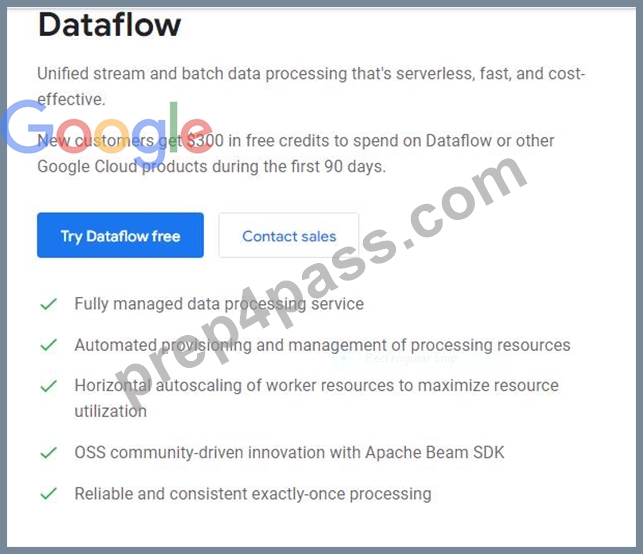
Reference link- https://cloud.google.com/dataflow
NEW QUESTION 193
Considering Different Storage and database options e.g. Cloud Datastore, Cloud SQL, Cloud Stor-age, etc. Which of the following statements is/are correct? ( Select two answer)
- A. Cloud DataStore and Cloud SQL have Terabytes + and Terabytes Capacity respec-tively.
- B. None of the above.
- C. Cloud Bigtable and Cloud Storage both have Petabytes + capacity.
- D. Cloud Bigtable and Cloud Storage both have not Petabytes + capacity.
Answer: A,C
NEW QUESTION 194
Which technology allows organizations to run multiple computer operating systems on a single piece of physical hardware?
- A. Containers
- B. Hypervisor
- C. Open source
- D. Serverless computing
Answer: B
NEW QUESTION 195
Customer Managed Encryption Keys (CMEK) can be used for encrypting data inside Cloud BigTable, which of the following statements is/are correct. (Select two answer)
- A. You can not use the same CMEK key in multiple projects
- B. Administrators can not rotate
- C. CMEK can only be configured at the cluster level.
- D. Not supported for instances that have clustered in more than one region.
Answer: C,D
Explanation:
Customer-managed encryption keys for Cloud BigTable.
By default, all the data at rest in Cloud Bigtable is encrypted using Google's default encryption. Bigtable handles and manages this encryption for you without any additional action on your part.
If you have specific compliance or regulatory requirements related to the keys that protect your data, you can use customer-managed encryption keys (CMEK) for BigTable. Instead of Google managing the encryption keys that protect your data, your BigTable instance is protected using a key that you control and manage in Cloud Key Management Service (Cloud KMS).
Features
Security: CMEK provides the same level of security as Google's default encryption but provides more administrative control.
Data access control: Administrators can rotate, manage access to, and disable or destroy the key used to protect data at rest in BigTable .
Auditability: All actions on your CMEK keys are logged and viewable in Cloud Logging.
Comparable performance: BigTable CMEK-protected instances offer comparable performance to BigTable instances that use Google default encryption.
Flexibility: You can use the same CMEK key in multiple projects or instances or you can use separate keys, depending on your business needs.
NEW QUESTION 196
An organization wants to migrate legacy applications currently hosted in their data center to the cloud. The current architecture dictates that each application needs its own operating system (OS) instead of sharing an OS.
Which infrastructure solution should they choose?
- A. Containers
- B. Virtual machines
- C. Open source
- D. Serverless computing
Answer: B
Explanation:
Virtual machines - you can install customized OS
Containers - about applications
Virtualization enables you to run multiple operating systems on the hardware of a single physical server, while containerization enables you to deploy multiple applications using the same operating system on a single virtual machine or server. Serverless computing would be no OS required and the open source operating system allows the use of code that is freely distributed and available to anyone and for commercial purposes such as Linux and Free BSD.
NEW QUESTION 197
......
Cloud-Digital-Leader exam dumps with real Google questions and answers: https://validtorrent.prep4pass.com/Cloud-Digital-Leader_exam-braindumps.html
