

Download Microsoft AZ-500 Mock Test Study Material
AZ-500 Questions Prepare with Learning Information
Microsoft AZ-500 exam measures the candidate's ability to secure Azure resources and services, including Azure identity and access, Azure platform protection, data and application protection, and network security. AZ-500 exam also covers topics such as Azure governance features, monitoring and reporting, and compliance and regulatory requirements.
NEW QUESTION # 197
You have an Azure AD tenant named contoso.com that has Azure AD Premium P1 licenses.
You need to create a group named Group1 that will be assigned the Global reader role.
Which portal should you use to create Group1 and which type of group should you create? To answer, select the appropriate options in the answer area.
NOTE: Each correct selection is worth one point
Answer:
Explanation: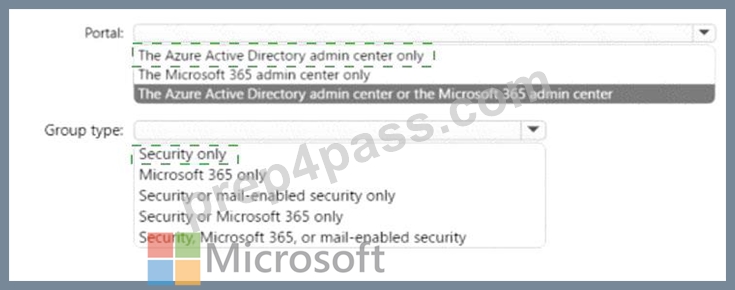
Explanation
https://learn.microsoft.com/en-us/azure/active-directory/roles/groups-create-eligible
NEW QUESTION # 198
You are configuring just in time (JIT) VM access to a set of Azure virtual machines.
You need to grant users PowerShell access to the virtual machine by using JIT VM access.
What should you configure? To answer, select the appropriate options in the answer area.
NOTE: Each correct selection is worth one point.
Answer:
Explanation:
Explanation:
1. Read permission
2. 5986
https://docs.microsoft.com/en-us/azure/security-center/just-in-time-explained#what-permissions-are-needed- to-configure-and-use-jit
NEW QUESTION # 199
You plan to implement an Azure function named Function1 that will create new storage accounts for containerized application instances.
You need to grant Function1 the minimum required privileges to create the storage accounts. The solution must minimize administrative effort.
What should you do? To answer, select the appropriate options in the answer area.
NOTE: Each correct selection is worth one point.
Answer:
Explanation: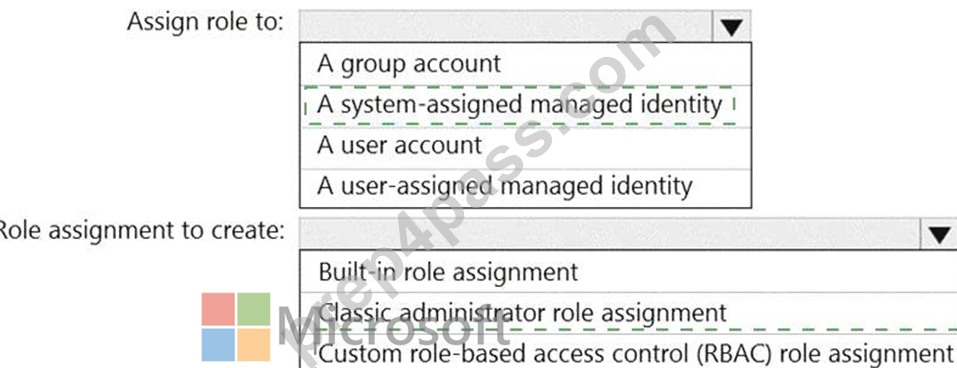
Explanation:
Reference:
https://docs.microsoft.com/en-us/azure/active-directory/managed-identities-azure-resources/overview
https://docs.microsoft.com/en-us/azure/active-directory/managed-identities-azure-resources/howto-assign- access-portal
NEW QUESTION # 200
What is the membership of Group1 and Group2? To answer, select the appropriate options in the answer area.
NOTE: Each correct selection is worth one point.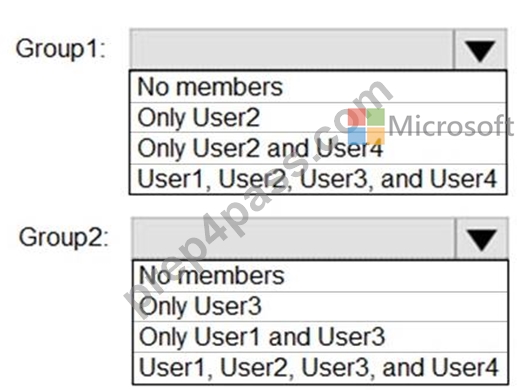
Answer:
Explanation:
Reference:
https://docs.microsoft.com/en-us/azure/active-directory/users-groups-roles/groups-dynamic-membership
Topic 1, Contoso
Overview
This is a case study. Case studies are not timed separately. You can use as much exam time as you would like to complete each case. However, there may be additional case studies and sections on this exam. You must manage your time to ensure that you are able to complete all questions included on this exam in the time provided.
To answer the questions included in a case study, you will need to reference information that is provided in the case study. Case studies might contain exhibits and other resources that provide more information about the scenario that is described in the case study. Each question is independent of the other question on this case study.
At the end of this case study, a review screen will appear. This screen allows you to review your answers and to make changes before you move to the next sections of the exam. After you begin a new section, you cannot return to this section.
To start the case study
To display the first question on this case study, click the Next button. Use the buttons in the left pane to explore the content of the case study before you answer the questions. Clicking these buttons displays information such as business requirements, existing environment, and problem statements. If the case study has an All Information tab, note that the information displayed is identical to the information displayed on the subsequent tabs. When you are ready to answer a question, click the Question button to return to the question.
Overview
Contoso, Ltd. is a consulting company that has a main office in Montreal and two branch offices in Seattle and New York.
The company hosts its entire server infrastructure in Azure.
Contoso has two Azure subscriptions named Sub1 and Sub2. Both subscriptions are associated to an Azure Active Directory (Azure AD) tenant named contoso.com.
Technical Requirements
Contoso identifies the following technical requirements:
Deploy Azure Firewall to VNetWork1 in Sub2.
Register an application named App2 in contoso.com.
Whenever possible, use the principle of least privilege.
Enable Azure AD Privileged Identity Management (PIM) for contoso.com
Existing Environment
Azure AD
Contoso.com contains the users shown in the following table.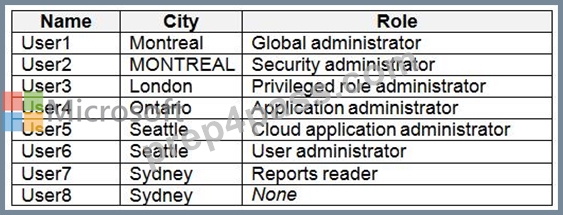
Contoso.com contains the security groups shown in the following table.
Sub1
Sub1 contains six resource groups named RG1, RG2, RG3, RG4, RG5, and RG6.
User2 creates the virtual networks shown in the following table.
Sub1 contains the locks shown in the following table.
Sub1 contains the Azure policies shown in the following table.
Sub2
Sub2 contains the virtual machines shown in the following table.
All virtual machines have the public IP addresses and the Web Server (IIS) role installed. The firewalls for each virtual machine allow ping requests and web requests.
Sub2 contains the network security groups (NSGs) shown in the following table.
NSG1 has the inbound security rules shown in the following table.
NSG2 has the inbound security rules shown in the following table.
NSG3 has the inbound security rules shown in the following table.
NSG4 has the inbound security rules shown in the following table.
NSG1, NSG2, NSG3, and NSG4 have the outbound security rules shown in the following table.
Contoso identifies the following technical requirements:
Deploy Azure Firewall to VNetwork1 in Sub2.
Register an application named App2 in contoso.com.
Whenever possible, use the principle of least privilege.
Enable Azure AD Privileged Identity Management (PIM) for contoso.com.
NEW QUESTION # 201
You have an Azure subscription that has a managed identity named identity and is linked to an Azure Active Directory (Azure AD) tenant. The tenant contains the resources shown in the following table.
Which resources can be added to AUI and AU2? To answer, select the appropriate options in the answer area.
Which resources can be added to AU1 and AU2? To answer, select the appropriate options in the answer area.
NOTE: Each correct selection is worth one point.
Answer:
Explanation: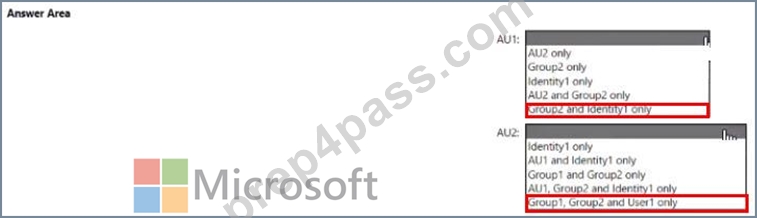
NEW QUESTION # 202
You need to configure an access review. The review will be assigned to a new collection of reviews and reviewed by resource owners.
Which three actions should you perform in sequence? To answer, move the appropriate actions from the list of actions to the answer area and arrange them in the correct order.
Answer:
Explanation:
Explanation
Step 1: Create an access review program
Step 2: Create an access review control
Step 3: Set Reviewers to Group owners
In the Reviewers section, select either one or more people to review all the users in scope. Or you can select to have the members review their own access. If the resource is a group, you can ask the group owners to review.
References:
https://docs.microsoft.com/en-us/azure/active-directory/governance/create-access-review
https://docs.microsoft.com/en-us/azure/active-directory/governance/manage-programs-controls
NEW QUESTION # 203
You have an Azure subscription named Sub1. Sub1 has an Azure Storage account named Storage1 that contains the resources shown in the following table.
You generate a shared access signature (SAS) to connect to the blob service and the file service.
Which tool can you use to access the contents in Container1 and Share! by using the SAS? To answer, select the appropriate options in the answer area.
NOTE: Each correct selection is worth one point.
Answer:
Explanation:
NEW QUESTION # 204
You have an Azure Storage account named storage1 and an Azure virtual machine named VM1. VM1 has a premium SSD managed disk.
You need to enable Azure Disk Encryption for VM1.
Which three actions should you perform in sequence? To answer, move the appropriate actions from the list of actions to the answer area and arrange then in the correct order.
Answer:
Explanation:
Explanation:
Graphical user interface, text, application Description automatically generated
Reference:
https://docs.microsoft.com/en-us/azure/virtual-machines/windows/disk-encryption-key-vault
NEW QUESTION # 205
You are troubleshooting a security issue for an Azure Storage account.
You enable the diagnostic logs for the storage account. What should you use to retrieve the diagnostics logs?
- A. the Security & Compliance admin center
- B. AzCopy
- C. SQL query editor in Azure
- D. File Explorer in Windows
Answer: A
NEW QUESTION # 206
You have an Azure AD tenant that contains the users shown in the following table.
You need to ensure that the users cannot create app passwords. The solution must ensure that User1 can continue to use the Mail and Calendar app.
What should you do?
- A. Create a new app registration.
- B. Configure a multi-factor authentication (MFA) registration policy.
- C. Enable Azure AD Password Protection.
- D. Assign User! the Authentication Policy Administrator role.
Answer: B
NEW QUESTION # 207
You have an Azure subscription that contains an Azure key vault named KeyVault1 and the virtual machines shown in the following table.
You enable the Azure Disk Encryption for volume encryption KeyVault1 setting.
KeyVault1 is configured as shown in the following exhibit.
For each of the following statements, select Yes if the statement is true. Otherwise, select No.
NOTE: Each correct selection is worth one point.
Answer:
Explanation:
Explanation:
NEW QUESTION # 208
You have an Azure subscription that contains a user named Admin1 and a resource group named RG1.
In Azure Monitor, you create the alert rules shown in the following table.
Admin1 performs the following actions on RG1:
* Adds a virtual network named VNET1
* Adds a Delete lock named Lock1
Which rules will trigger an alert as a result of the actions of Admin1? To answer, select the appropriate options in the answer area.
NOTE: Each correct selection is worth one point.
Answer:
Explanation:
Explanation
NEW QUESTION # 209
You have an Azure subscription named Sub1 that is associated to an Azure Active Directory (Azure AD) tenant named contoso.com.
An administrator named Admin1 has access to the following identities:
An OpenID-enabled user account
A Hotmail account
An account in contoso.com
An account in an Azure AD tenant named fabrikam.com
You plan to use Azure Account Center to transfer the ownership of Sub1 to Admin1.
To which accounts can you transfer the ownership of Sub1?
- A. contoso.com and fabrikam.com only
- B. contoso.com, fabrikam.com, Hotmail, and OpenID-enabled user account
- C. contoso.com only
- D. contoso.com, fabrikam.com, and Hotmail only
Answer: A
Explanation:
Explanation
When you transfer billing ownership of your subscription to an account in another Azure AD tenant, you can move the subscription to the new account's tenant. If you do so, all users, groups, or service principals who had role based access (RBAC) to manage subscriptions and its resources lose their access. Only the user in the new account who accepts your transfer request will have access to manage the resources.
Reference:
https://docs.microsoft.com/en-us/azure/billing/billing-subscription-transfer
https://docs.microsoft.com/en-us/azure/billing/billing-subscription-transfer#transferring-subscription-to-anacco
NEW QUESTION # 210
You have a management group named MG1 that contains an Azure subscription and a resource group named RG1. RG1 contains a virtual machine named VM1. You have the custom Azure roles shown in the following table.
The permissions for Role1 are shown in the following role definition file.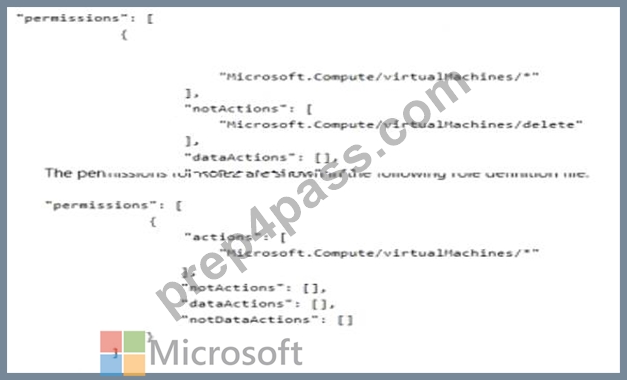
You assign the roles to the users shown in the following table.
For each of the following statements, select Yes if the statement is true. Otherwise, select No NOTE: Each correct selection is worth one point.
Answer:
Explanation:
Explanation:
NEW QUESTION # 211
You have an Azure Sentinel workspace that has an Azure Active Directory (Azure AD) data connector.
You are threat hunting suspicious traffic from a specific IP address.
You need to annotate an intermediate event stored in the workspace and be able to reference the IP address when navigating through the investigation graph.
Which three actions should you perform in sequence? To answer, move the appropriate actions from the list of actions to the answer area and arrange them in the correct order.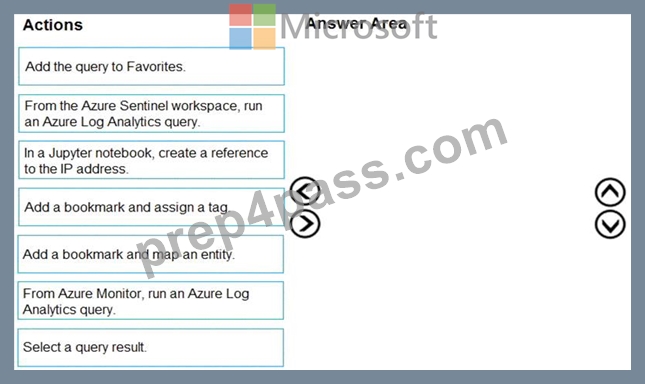
Answer:
Explanation:
Explanation
Reference:
https://docs.microsoft.com/en-us/azure/sentinel/bookmarks
Topic 2, Litware, inc
This is a case study. Case studies are not timed separately. You can use as much exam time as you would like to complete each case. However, there may be additional case studies and sections on this exam. You must manage your time to ensure that you are able to complete all questions included on this exam in the time provided.
To answer the questions included in a case study, you will need to reference information that is provided in the case study. Case studies might contain exhibits and other resources that provide more information about the scenario that is described in the case study. Each question is independent of the other question on this case study.
At the end of this case study, a review screen will appear. This screen allows you to review your answers and to make changes before you move to the next sections of the exam. After you begin a new section, you cannot return to this section.
To start the case study
To display the first question on this case study, click the Next button. Use the buttons in the left pane to explore the content of the case study before you answer the questions. Clicking these buttons displays information such as business requirements, existing environment, and problem statements. If the case study has an All Information tab, note that the information displayed is identical to the information displayed on the subsequent tabs. When you are ready to answer a question, click the Question button to return to the question.
Overview
Litware, Inc. is a digital media company that has 500 employees in the Chicago area and 20 employees in the San Francisco area.
Existing Environment
Litware has an Azure subscription named Sub1 that has a subscription ID of
43894a43-17c2-4a39-8cfc-3540c2653ef4.
Sub1 is associated to an Azure Active Directory (Azure AD) tenant named litwareinc.com. The tenant contains the user objects and the device objects of all the Litware employees and their devices. Each user is assigned an Azure AD Premium P2 license. Azure AD Privileged Identity Management (PIM) is activated.
The tenant contains the groups shown in the following table.
The Azure subscription contains the objects shown in the following table.
Azure Security Center is set to the Free tier.
Planned changes
Litware plans to deploy the Azure resources shown in the following table.
Litware identifies the following identity and access requirements:
All San Francisco users and their devices must be members of Group1.
The members of Group2 must be assigned the Contributor role to Resource Group2 by using a permanent eligible assignment.
Users must be prevented from registering applications in Azure AD and from consenting to applications that access company information on the users' behalf.
Platform Protection Requirements
Litware identifies the following platform protection requirements:
Microsoft Antimalware must be installed on the virtual machines in Resource Group1.
The members of Group2 must be assigned the Azure Kubernetes Service Cluster Admin Role.
Azure AD users must be to authenticate to AKS1 by using their Azure AD credentials.
Following the implementation of the planned changes, the IT team must be able to connect to VM0 by using JIT VM access.
A new custom RBAC role named Role1 must be used to delegate the administration of the managed disks in Resource Group1. Role1 must be available only for Resource Group1.
Security Operations Requirements
Litware must be able to customize the operating system security configurations in Azure Security Center.
NEW QUESTION # 212
From Azure Security Center, you enable Azure Container Registry vulnerability scanning of the images in
Registry1.
You perform the following actions:
Push a Windows image named Image1 to Registry1.
Push a Linux image named Image2 to Registry1.
Push a Windows image named Image3 to Registry1.
Modify Image1 and push the new image as Image4 to Registry1.
Modify Image2 and push the new image as Image5 to Registry1.
Which two images will be scanned for vulnerabilities? Each correct answer presents a complete solution.
NOTE: Each correct selection is worth one point.
- A. Image5
- B. Image1
- C. Image4
- D. Image3
- E. Image2
Answer: B,E
NEW QUESTION # 213
You have an Azure subscription that contains a storage account named storage1 and several virtual machines.
The storage account and virtual machines are in the same Azure region. The network configurations of the virtual machines are shown in the following table.
The virtual network subnets have service endpoints defined as shown in the following table.
You configure the following Firewall and virtual networks settings for storage1:
* Allow access from: Selected networks
* Virtual networks: VNET3\Subnet3
* Firewall - Address range: 52.233.129.0/24
For each of the following statements, select Yes if the statement is true. Otherwise, select No.
NOTE: Each correct selection is worth one point.
Answer:
Explanation:
Explanation:
Box 1: No
VNet1 has a service endpoint configure for Azure Storage. However, the Azure storage does not allow access from VNet1 or the public IP address of VM1.
Box 2: Yes
VNet2 does not have a service endpoint configured. However, the Azure storage allows access from the public IP address of VM2.
Box 3: No
Azure storage allows access from VNet3. However, VNet3 does not have a service endpoint for Azure storage. The Azure storage also does not allow access from the public IP of VM3.
NEW QUESTION # 214
SIMULATION
Use the following login credentials as needed:
To enter your username, place your cursor in the Sign in box and click on the username below.
To enter your password, place your cursor in the Enter password box and click on the password below.
Azure Username: [email protected]
Azure Password: Ag1Bh9!#Bd
The following information is for technical support purposes only:
Lab Instance: 10598168

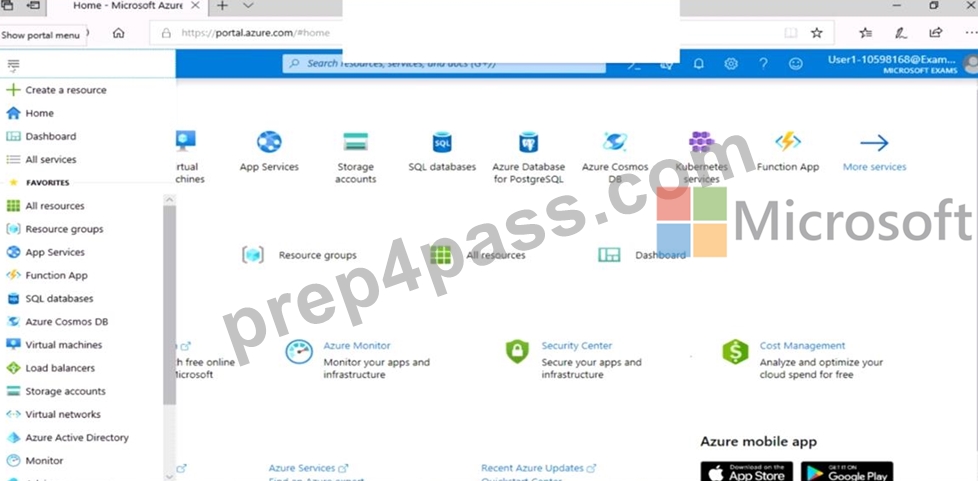

You need to prevent administrative users from accidentally deleting a virtual network named VNET1. The administrative users must be allowed to modify the settings of VNET1.
To complete this task, sign in to the Azure portal.
- A. Locking prevents other users in your organization from accidentally deleting or modifying critical resources, such as Azure subscription, resource group, or resource.
Note: In Azure, the term resource refers to an entity managed by Azure. For example, virtual machines, virtual networks, and storage accounts are all referred to as Azure resources.
1. In the Settings blade for virtual network VNET, select Locks.
2. To add a lock, select Add.
3. For Lock type select Delete lock, and click OK - B. Locking prevents other users in your organization from accidentally deleting or modifying critical resources, such as Azure subscription, resource group, or resource.
Note: In Azure, the term resource refers to an entity managed by Azure. For example, virtual machines, virtual networks, and storage accounts are all referred to as Azure resources.
1. In the Settings blade for virtual network VNET, select Locks.
2. To add a lock, select Add.
3. For Lock type select Delete lock, and click OK
Answer: B
Explanation:
Reference:
https://docs.microsoft.com/en-us/azure/azure-resource-manager/resource-group-lock-resources
NEW QUESTION # 215
You create an alert rule that has the following settings:
Resource: RG1
Condition: All Administrative operations
Actions: Action groups configured for this alert rule: ActionGroup1
Alert rule name: Alert1
You create an action rule that has the following settings:
Scope: VM1
Filter criteria: Resource Type = "Virtual Machines"
Define on this scope: Suppression
Suppression config: From now (always)
Name: ActionRule1
For each of the following statements, select Yes if the statement is true. Otherwise, select No.
Note: Each correct selection is worth one point.
Answer:
Explanation:
References:
https://docs.microsoft.com/en-us/azure/azure-monitor/platform/alerts-activity-log
https://docs.microsoft.com/en-us/azure/azure-monitor/platform/alerts-action-rules
NEW QUESTION # 216
You need to configure WebApp1 to meet the data and application requirements.
Which two actions should you perform? Each correct answer presents part of the solution.
NOTE: Each correct selection is worth one point.
- A. Turn on the HTTPS Only protocol setting.
- B. Upload a public certificate.
- C. Set the Minimum TLS Version protocol setting to 1.2.
- D. Change the pricing tier of the App Service plan.
- E. Turn on the Incoming client certificates protocol setting.
Answer: A,E
Explanation:
Refer https://docs.microsoft.com/en-us/azure/app-service/app-service-web-configure-tls-mutual-auth
Topic 2, Contoso
Please wait while the virtual machine loads. Once loaded, you may proceed to the lab section. This may take a few minutes, and the wait time will not be deducted from your overall test time.
When the Next button is available, click it to access the lab section. In this section, you will perform a set of tasks in a live environment. While most functionality will be available to you as it would be in a live environment some functionality (e.g., copy and paste, ability to navigate to external websites) will not be possible by design.
Scoring is based on the outcome of performing the tasks stated in the lab. In other words, it doesn't matter how you accomplish the task, if you successfully perform it, you will earn credit for that task.
Labs are not timed separately, and this exam may have more than one lab that you must complete. You can use as much time as you would like to complete each lab. But, you should manage your time appropriately to ensure that you are able to complete the lab{s) and all Please note that once you submit your work by clicking the Next button within a lab.
Task 1:
You need to configure Azure to allow RDP connections from the Internet to a virtual machine named VM1. The solution must minimize the attack surface of VM1.
To complete this task, sign in to the Azure portal.
Task 2:
You need to add the network interface of a virtual machine named VM1 to an application security group named ASG1.
To complete this task, sign in to the Azure portal.
Task 3:
You need to perform a full malware scan every Sunday at 02:00 on a virtual machine named VM1 by using Microsoft Antimalware for Virtual Machines.
Task 4:
The developers at your company plan to create a web app named App103178O6 and to publish the app to htlps://www.contoso.com.
You need to perform the following tasks:
* Ensure that App10317806 is registered lo Azure Active Directory (Azure AD).
* Generate a password for App10317806.
Task 5:
You need to prevent administrative users from accidentally deleting a virtual network named VNET1. The administrative users must be allowed to modify the settings of VNET1.
Task 6:
You need to ensure that a user named user2103l7806 can manage the properties of the virtual machines in the RG1lod10317806 resource group. The solution must use the principle of least privilege.
Task 7:
You need to ensure that only devices connected to a 131.107.0.0/16 subnet can access data in the railod10317806 Azure Storage account, Task 8:
You need to email an alert to a user named [email protected] if the average CPU usage of a virtual machine named VM1 is greater than 70 percent for a period of 15 minutes.
Task 9:
You need to collect all the audit failure data from the security log of a virtual machine named VM1 to an Azure Storage account.
To complete this task, sign in to the Azure portal.
This task might take several minutes to complete. You can perform other tasks while the task completes.
Task 10:
You need to prevent HTTP connections to the rg1lodl03l7806n1 Azure Storage account.
Task 11:
You need to ensure that the rg1lod10317806n1 Azure Storage account is encrypted by using a key stored in the KeyVault10317806 Azure key vault.
Task 12:
You need to create a new Azure Active Directory (Azure AD) directory named 10317806.onmicrosoft.com. The new directory must contain a user named userl103l7806.onmicrosoft.com who is configured to sign in by using Azure Multi-Factor Authentication (MFA).
This is a case study. Case studies are not timed separately. You can use as much exam time as you would like to complete each case. However, there may be additional case studies and sections on this exam. You must manage your time to ensure that you are able to complete all questions included on this exam in the time provided.
To answer the questions included in a case study, you will need to reference information that is provided in the case study. Case studies might contain exhibits and other resources that provide more information about the scenario that is described in the case study. Each question is independent of the other question on this case study.
At the end of this case study, a review screen will appear. This screen allows you to review your answers and to make changes before you move to the next sections of the exam. After you begin a new section, you cannot return to this section.
To start the case study
To display the first question on this case study, click the Next button. Use the buttons in the left pane to explore the content of the case study before you answer the questions. Clicking these buttons displays information such as business requirements, existing environment, and problem statements. If the case study has an All Information tab, note that the information displayed is identical to the information displayed on the subsequent tabs. When you are ready to answer a question, click the Question button to return to the question.
Overview
Contoso, Ltd. is a consulting company that has a main office in Montreal and two branch offices in Seattle and New York.
The company hosts its entire server infrastructure in Azure.
Contoso has two Azure subscriptions named Sub1 and Sub2. Both subscriptions are associated to an Azure Active Directory (Azure AD) tenant named contoso.com.
Technical Requirements
Contoso identifies the following technical requirements:
* Deploy Azure Firewall to VNetWork1 in Sub2.
* Register an application named App2 in contoso.com.
* Whenever possible, use the principle of least privilege.
* Enable Azure AD Privileged Identity Management (PIM) for contoso.com
Existing Environment
Azure AD
Contoso.com contains the users shown in the following table.
Contoso.com contains the security groups shown in the following table.
Sub1
Sub1 contains six resource groups named RG1, RG2, RG3, RG4, RG5, and RG6.
User2 creates the virtual networks shown in the following table.
Sub1 contains the locks shown in the following table.
Sub1 contains the Azure policies shown in the following table.
Sub2
Sub2 contains the virtual machines shown in the following table.
All virtual machines have the public IP addresses and the Web Server (IIS) role installed. The firewalls for each virtual machine allow ping requests and web requests.
Sub2 contains the network security groups (NSGs) shown in the following table.
NSG1 has the inbound security rules shown in the following table.
NSG2 has the inbound security rules shown in the following table.
NSG3 has the inbound security rules shown in the following table.
NSG4 has the inbound security rules shown in the following table.
NSG1, NSG2, NSG3, and NSG4 have the outbound security rules shown in the following table.
Contoso identifies the following technical requirements:
* Deploy Azure Firewall to VNetwork1 in Sub2.
* Register an application named App2 in contoso.com.
* Whenever possible, use the principle of least privilege.
* Enable Azure AD Privileged Identity Management (PIM) for contoso.com.
NEW QUESTION # 217
Your company has an Azure subscription named Subscription1 that contains the users shown in the following table.
The company is sold to a new owner.
The company needs to transfer ownership of Subscription1.
Which user can transfer the ownership and which tool should the user use? To answer, select the appropriate options in the answer area.
NOTE: Each correct selection is worth one point.
Answer:
Explanation: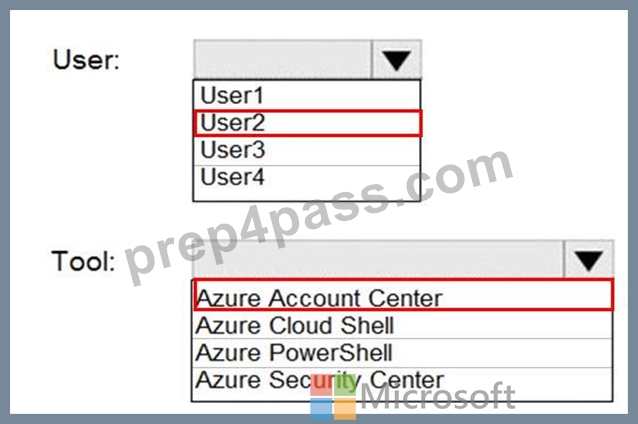
Reference:
https://docs.microsoft.com/en-us/azure/billing/billing-subscription-transfer#transfer-billing-ownership-of-an-azure-subscription
NEW QUESTION # 218
You have an Azure key vault.
You need to delegate administrative access to the key vault to meet the following requirements:
Provide a user named User1 with the ability to set advanced access policies for the key vault.
Provide a user named User2 with the ability to add and delete certificates in the key vault.
Use the principle of least privilege.
What should you use to assign access to each user? To answer, select the appropriate options in the answer area.
NOTE: Each correct selection is worth one point.
Answer:
Explanation:
Reference:
https://docs.microsoft.com/en-us/azure/key-vault/key-vault-secure-your-key-vault
NEW QUESTION # 219
You have an Azure subscription. The subscription contains Azure virtual machines that run Windows Server 2016.
You need to implement a policy to ensure that each virtual machine has a custom antimalware virtual machine extension installed.
How should you complete the policy? To answer, select the appropriate options in the answer area.
NOTE: Each correct selection is worth one point.
Answer:
Explanation:
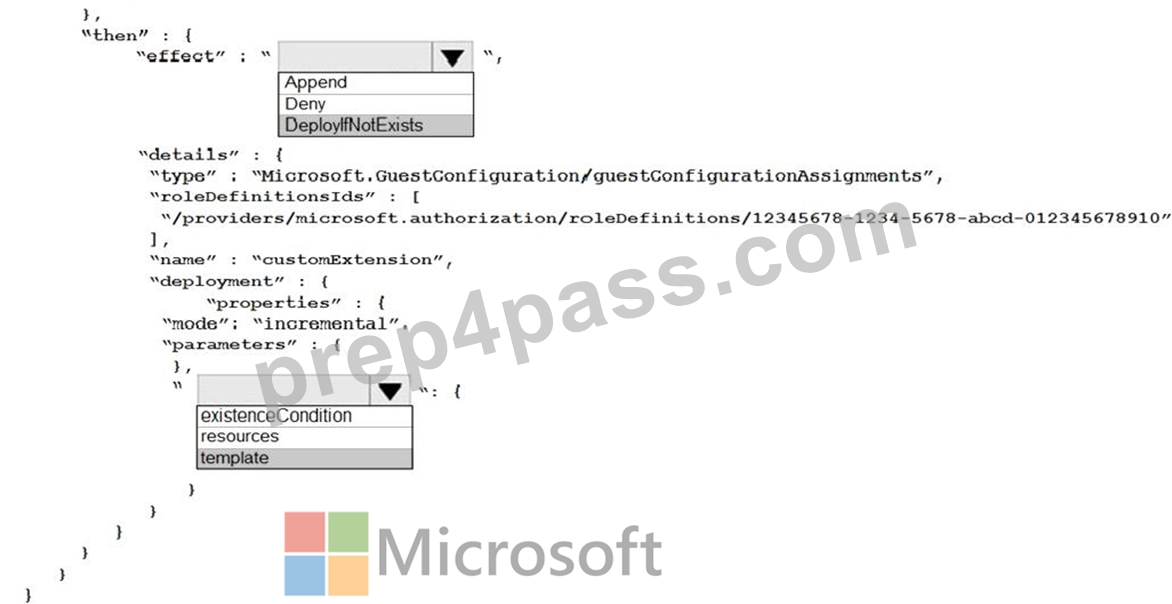
References:
https://docs.microsoft.com/en-us/azure/governance/policy/concepts/effects
NEW QUESTION # 220
You have an Azure Active Directory (Azure AD) tenant that contains the resources shown in the following table.
User2 is the owner of Group2.
The user and group settings for App1 are configured as shown in the following exhibit.
You enable self-service application access for App1 as shown in the following exhibit.
User3 is configured to approve access to Appl.
You need to identify the owners of Group2 and the users of Appl.
What should you identify? To answer, select the appropriate options in the answer area.
NOTE: Each correct selection is worth one point.
Answer:
Explanation:
Explanation
Reference:
https://docs.microsoft.com/en-us/azure/active-directory/manage-apps/manage-self-service-access
NEW QUESTION # 221
......
The Microsoft AZ-500 exam consists of a variety of question types, including multiple choice, case studies, and drag-and-drop questions. AZ-500 exam is designed to test both theoretical knowledge and practical application of Azure security concepts. Candidates are given 150 minutes to complete the exam and must score at least 700 out of 1000 points to pass.
Most Reliable Microsoft AZ-500 Training Materials: https://validtorrent.prep4pass.com/AZ-500_exam-braindumps.html
