

100% Pass Your 300-420 Exam Dumps at First Attempt with Prep4pass
Penetration testers simulate 300-420 exam PDF
Cisco 300-420 exam is designed to assess the candidate’s knowledge of enterprise network design principles, theories, and best practices. 300-420 exam covers a wide range of topics such as advanced routing protocols, WAN technologies, virtualization, network automation, security, and network services. 300-420 exam is designed to test the candidate’s skills in designing, implementing, and troubleshooting complex enterprise networks.
NEW QUESTION # 12
Refer to the exhibit.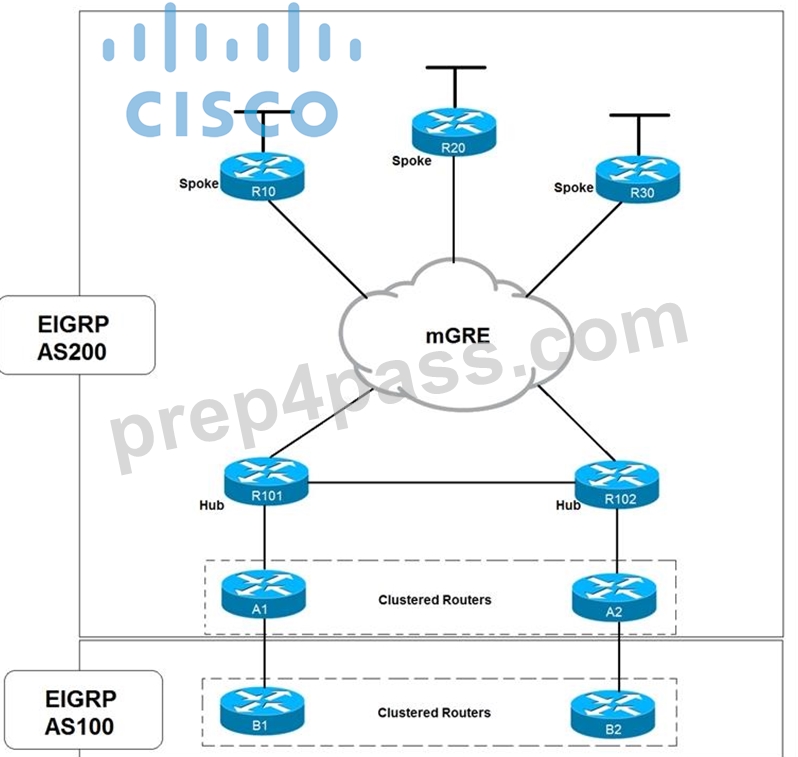
Which solution decreases the EIGRP convergence time?
- A. Increase the hold time value
- B. Increase the dead timer value
- C. Enable subsecond timers
- D. Enable stub routing on the spokes
Answer: D
NEW QUESTION # 13
Drag and drop the characteristics from the left onto the YANG modules they describe on the right. Not all options are used.
Answer:
Explanation:
NEW QUESTION # 14
The implementations group has been using the test bed to do a 'proof-of-concept' that requires both Client 1 and Client 2 to access the WEB Server at 209.65.200.241. After several changes to the network addressing, routing scheme, DHCP services, NTP services, layer 2 connectivity, FHRP services, and device security, a trouble ticket has been opened indicating that Client 1 cannot ping the 209.65.200.241 address.
Use the supported commands to isolated the cause of this fault and answer the following questions.
The fault condition is related to which technology?
- A. IPv4 layer 3 security
- B. IP NAT
- C. IPv4 OSPF Redistribution
- D. BGP
- E. IPv6 OSPF Routing
- F. NTP
- G. IPv4 OSPF Routing
Answer: G
Explanation:
On R1, for IPV4 authentication of OSPF the command is missing and required to configure------ ip ospf authentication message-digest
NEW QUESTION # 15
An engineer must design a VPN solution for a company that has multiple branches connecting to a main office. What are two advantages of using DMVPN instead of IPsec tunnels to accomplish this task? (Choose two.)
- A. lower traffic overhead
- B. support for AES 256-bit encryption
- C. dynamic spoke-to-spoke tunnels
- D. greater scalability
- E. support for anycast gateway
Answer: C,D
NEW QUESTION # 16
What is an advantage of designing an out-of-band network management solution?
- A. In the event of a production network outage, it can be used as a backup network path.
- B. There is no separation between the production network and the management network.
- C. In the event of a production network outage, network devices can still be managed.
- D. It is less expensive than an in-band management solution
Answer: C
NEW QUESTION # 17
An infrastructure team is concerned about the shared memory utilization of a device, and for this reason, they need to monitor the device state. Which solution limits impact on the device and provides the required data?
- A. static telemetry
- B. IPFIX
- C. on-change subscription
- D. periodic subscription
Answer: C
Explanation:
There are two types of subscriptions: periodic and on-change. With periodic subscription, data is streamed out to the destination at the configured interval. It continuously sends data for the lifetime of that subscription. With on-change, data is published only when a change in the data occurs such as when an interface or OSPF neighbor goes down. https://developer.cisco.com/docs/ios-xe/#!streaming-telemetry-quick-start-guide/streaming-telemetry
NEW QUESTION # 18
Which control-plane technology allows the same subnet to exist across multiple network locations?
- A. VXLAN
- B. FabricPath
- C. LISP
- D. ISE mobility services
Answer: C
Explanation:
https://www.cisco.com/c/en/us/td/docs/solutions/CVD/Campus/cisco-sda-design-guide.html
NEW QUESTION # 19
An engineer is creating a design to enable IPv6 to run on an existing IPv4 IS-IS network. The IPv4 and IPv6 topologies will match exactly, and the engineer plans to use the same router levels for each protocol per interface. Which IS-IS design is required?
- A. single topology without enabling transition feature
- B. multi topology with transition feature enabled
- C. multi topology without enabling transition feature
- D. single topology with transition feature enabled
Answer: D
Explanation:
Explanation
https://www.cisco.com/c/en/us/td/docs/ios-xml/ios/iproute_isis/configuration/xe-3s/irs-xe-3s-book/ip6-route-isis For single-topology IS-IS IPv6, routers must be configured to run the same set of address families. IS-IS performs consistency checks on hello packets and will reject hello packets that do not have thesame set of configured address families. For example, a router running IS-IS for both IPv4 and IPv6 will not form an adjacency with a router running IS-IS for IPv4 or IPv6 only. In order to allow adjacency to be formed in mismatched address-families network, the adjacency-check command in IPv6 address family configuration mode must be disabled.
NEW QUESTION # 20
Refer to the exhibit.
Refer to the exhibit. An architect must create a stable and scalable EIGRP solution for a customer. The design must:
* conserve bandwidth, memory, and CPU processing
* prevent suboptimal routing
* avoid any unnecessary queries
Which two solutions must the architect select? (Choose two.)
- A. prefix lists
- B. distribute lists
- C. route summarization
- D. stub routing
- E. static redistribution
Answer: B,C
NEW QUESTION # 21 
Refer to the exhibit. An architect must design a solution to connect the network behind R3 with the EIGRP network. Which mechanism should be included to avoid routing loops?
- A. summarization
- B. down bit
- C. route tags
- D. split horizon
Answer: C
Explanation:
Section: Advanced Addressing and Routing Solutions
NEW QUESTION # 22
Which method will filter routes between EIGRP neighbors within the same autonomous system?
- A. leak-map
- B. distribute-list
- C. route tagging
- D. policy-based routing
Answer: B
Explanation:
Section: Advanced Addressing and Routing Solutions
NEW QUESTION # 23
Refer to the exhibit.
An engineer must design a WAN solution so that ISP-1 is always preferred over ISP-2. The path via ISP-2 is considered as a backup and must be used only when the path to ISP-1 is down. Which solution must the engineer choose?
- A. R1:
- Routes advertised to ISP-1: 0x AS-path prepend
- Routes received from ISP-1: HIGH local-preference
- Routes advertised to R2: no action
- Routes received from R2: community NO-EXPORT
R2:
- Routes advertised to ISP-2:5x AS-path prepend
- Routes received from ISP-2: LOW local-preference
- Routes advertised to R1: community NO-ADVERTISE
- Routes received from R1: no action - B. R1:
- Routes advertised to ISP-1: 0x AS-path prepend
- Routes received from ISP-1: HIGH local-preference
- Routes advertised to R2: community NO-EXPORT
- Routes received from R2: no action
R2:
- Routes advertised to ISP-2: 5x AS-path prepend
- Routes received from ISP-2: LOW local-preference
- Routes advertised to R1: no action
- Routes received from R1: no action - C. R1:
- Routes advertised to ISP-1: 0x AS-path prepend
- Routes received from ISP-1: LOW local-preference
- Routes advertised to R2: community NO-ADVERTISE
- Routes received from R2: no action
R2:
- Routes advertised to ISP-2: 5x AS-path prepend
- Routes received from ISP-2: HIGH local-preference
- Routes advertised to R1: no action
- Routes received from R1: community NO-ADVERTISE - D. R1:
- Routes advertised to ISP-1: 5x AS-path prepend
- Routes received from ISP-1: LOW local-preference
- Routes advertised to R2: community NO-ADVERTISE
- Routes received from R2: no action
R2:
- Routes advertised to ISP-2: 0x AS-path prepend
- Routes received from ISP-2: HIGH local-preference
- Routes advertised to R1: community NO-EXPORT
- Routes received from R1: no action
Answer: B
NEW QUESTION # 24
Which PIM mode uses a shared tree only?
- A. dense
- B. sparse
- C. bidirectional
- D. source-specific
Answer: C
Explanation:
Explanation
In bidirectional mode, traffic is routed only along a bidirectional shared tree that is rooted at the rendezvous point (RP) for the group
https://www.cisco.com/c/en/us/td/docs/ios-xml/ios/ipmulti_pim/configuration/xe-16/imc-pim-xe-16-book/imc-te
NEW QUESTION # 25
A branch office has a primary L3VPN MPLS connection back to the main office and an IPSEC VPN tunnel that serves as backup. Which design ensures that data is sent over the backup connection only if the primary MPLS circuit is down?
- A. Use BGP with the multipath feature enabled to force traffic via the primary path when available.
- B. Use OSPF with a passive-interface
- C. Use static routes tied to an IP SLA to prefer the primary path while a floating static route points to the backup connection.
- D. Use EIGRP to establish a neighbor relationship with the main office via L3VPN MPLS and the IPSEC VPN tunnel.
Answer: C
NEW QUESTION # 26
A company has the following network infrastructure. (Refer to the exhibit.)
Router A is a GLBP active virtual gateway with priority level set to 250. Routers B and C are configured with the default GLPB configurations. The configuration of the active virtual gateway needs to be changed such that if the AVG fails, Router C should be elected to be used as an active virtual gateway. As the network administrator, you have been asked to make corresponding changes to the configuration.
Which command would you use for this purpose on Router C, and where would the command be configured?
- A. glbp 10 priority 200 (on Router C)
- B. glbp 10 preempt (on Router B)
- C. glbp 10 preempt (on Router C)
- D. glbp 10 priority 200 (on Router B)
Answer: A
Explanation:
You would configure the glbp 10 priority 200 command on Router C to change the configuration as required.
Gateway Load Balancing Protocol (GLBP) gateway priority determines the role that each GLBP gateway plays and what happens if the AVG fails. In the given scenario, Router A is used as an active virtual gateway. If the AVG in a LAN topology fails, an election process takes place to determine which backup virtual gateway should take over. When you configure this command on Router C, Router C will be elected when Router A fails as an AVG.
Once the configuration change is made, it can be verified by examining the output if the show run command as shown below:
In the above output, it can be determined that the glpb priority 200 command has been applied to the gigabitEthernet0/0 interface on Router
C. If the default priority of 100 had been applied, there would be no line in the output for priority. Because Router B is configured with the default configuration, it will have its priority set to the default level as 100.
You would not use the glbp 10 preempt command on Router B or the glbp 10 preempt command on Router C to change the configuration. You would use this command on a router to enable preemption. Preemption allows a virtual router that was once the AVG to assume its role as active virtual router when it comes back online if it has a higher priority than the current AVG. Alternatively, it can enable a new router with a higher priority to take the role of AVG from the current AVG if the new router has a higher AVG.
You would use not the glbp 10 priority 200 command on Router B to change the configuration. You would run this command if you needed Router B to be elected as the AVR instead of Router C, as running this command on Router B would configure it with higher priority than Router C.
Objective:
Infrastructure Services
Sub-Objective:
Configure and verify first-hop redundancy protocols
References:
Cisco > Home > End-of-Sale and End-of-Life Products > Cisco IOS Software Releases > 12.2T > Product Literature > White Papers > GLBP - Gateway Load Balancing Protocol Cisco > Cisco IOS IP Application Services Command Reference > glbp priority
NEW QUESTION # 27
Refer to the exhibit.
Refer to the exhibit A customer wants to adopt a dynamic site-to-site VPN solution to secure communication for VoIP, video, and FTP traffic between the remote branches and the headquarters. The customer also wants the branches to communicate directly, thereby reducing traffic at the headquarters location. The solution must consider that the branch routers are limited in available memory. Which VPN solution meets these requirements?
- A. DMVPN Phase 1 Hub and Spoke design
- B. DMVPN Phase 3 Hierarchical design
- C. DMVPN Phase 2 Hub and Spoke design
- D. DMVPN Phase 3 Hub and Spoke design
Answer: D
NEW QUESTION # 28
Which function does the Cisco SD-Access intermediate node perform?
- A. Route and transport IP traffic.
- B. Act as an anycast Layer 3 gateway.
- C. Map users to a virtual network.
- D. Act as LISP proxy tunnel router.
Answer: A
NEW QUESTION # 29
Which routes does the overlay management protocol advertise in an SD-WAN overlay?
- A. primary, backup, and load-balanced
- B. underlay, MPLS, and overlay
- C. prefix, TLOC, and service
- D. Internet, MPLS, and backup
Answer: C
Explanation:
Section: WAN for Enterprise Networks
NEW QUESTION # 30
A router running ISIS is showing high CPU and bandwidth utilization. An engineer discovers that the router is configured as L1/L2 and has L1 and L2 neighbors. Which step optimizes the design to address the issue?
- A. Configure each interface as either L1 or L2 circuit type
- B. Configure the router to be either L1 or L2
- C. Make this router a DIS for each of the interfaces
- D. Disable the default behavior of advertising the default route on the L1/L2 router
Answer: A
Explanation:
Section: Advanced Addressing and Routing Solutions
Explanation/Reference:
NEW QUESTION # 31
......
Cisco 300-420 exam is a challenging test that requires candidates to have a strong understanding of network design principles and technologies. To prepare for the exam, candidates should have experience designing and implementing enterprise networks using Cisco technologies. Candidates should also have a clear understanding of the exam objectives and the topics that will be covered on the exam.
All 300-420 Dumps and Training Courses: https://validtorrent.prep4pass.com/300-420_exam-braindumps.html
